
Every Live Superman Costume Ranked From Best to Worst
From the 1940 World's Fair and movie serials to Broadway, television and the modern DCU, we rank the costumes that brought Superman to life.
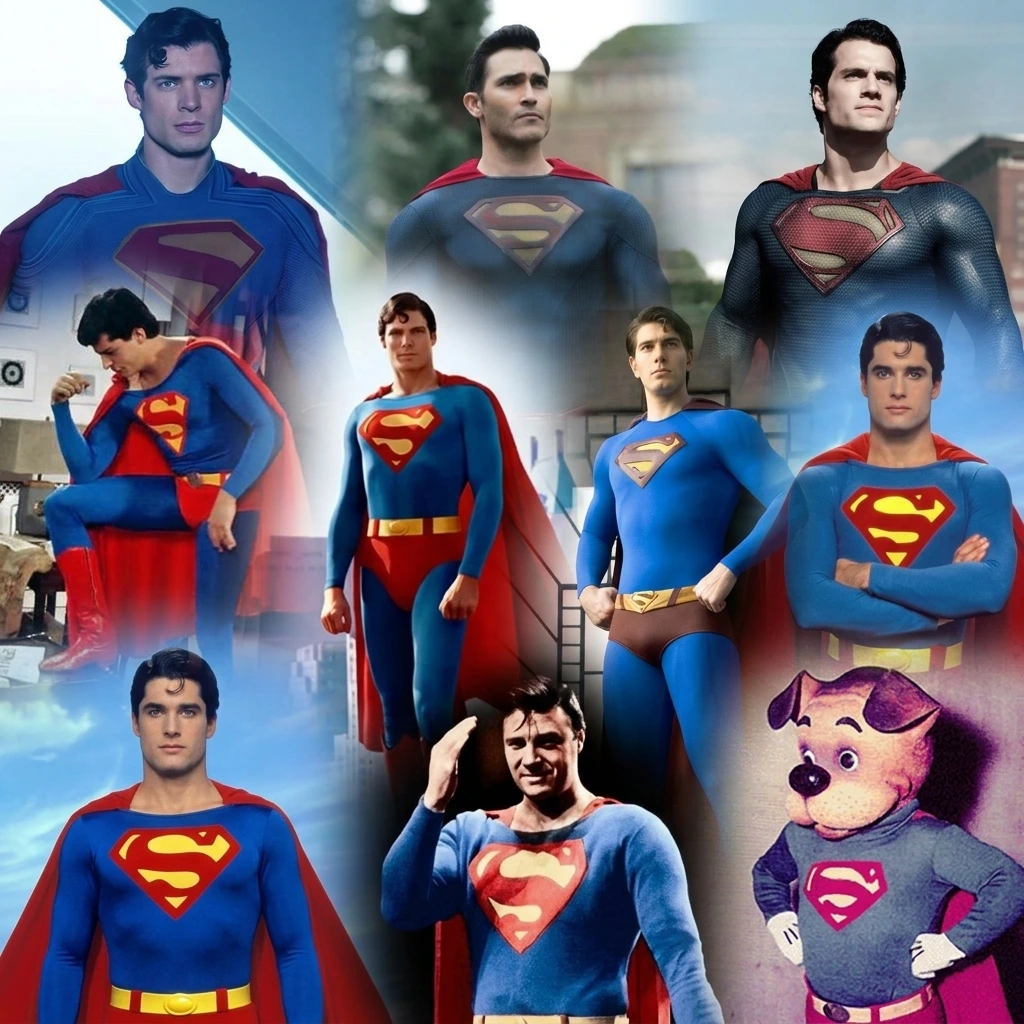
Few costumes in popular culture carry as much history as Superman's. The blue suit, red cape, boots and unmistakable shield have been reinterpreted for world's fairs, movie serials, Broadway stages, network television and theatrical blockbusters. Some versions pursued the simplicity of the comics while others treated the costume as Kryptonian clothing, a futuristic uniform or a deliberately nostalgic throwback. This ranking considers how successfully each design captures Superman's identity while also serving the performer, production and era for which it was created.
This is a ranking of the costumes, not the actors or performances. We considered silhouette, fit, color balance, chest emblem, cape, materials, originality, screen or stage presence and how well the finished design communicates Superman at a glance. Alternate suits are included only when they represent a substantial visual redesign. Voice-only performers and actors who appeared only as Clark Kent are acknowledged after the countdown, while Superman appearances created specifically for military recruiting films have been omitted. With those ground rules established, here is our revised countdown from the least successful live Superman costume to our favorite.
#21) Billy Curtis - “The Adventures of Superpup”
The costume from the unaired 1958 “The Adventures of Superpup” pilot occupies the bottom position largely because it was never intended to present Superman himself as a majestic superhero. Billy Curtis plays Bark Bent and Superpup in a canine parody of the George Reeves series, and the tiny cape-and-tights ensemble deliberately exaggerates the familiar Superman formula for comedy.
The recognizable colors and superhero silhouette give it historical charm, but the dog ears, broad theatrical styling and novelty construction make it impossible to place above costumes designed to sell Superman sincerely. It is an irresistible curiosity and an important piece of television history, but as a Superman costume design it is more spoof than definitive interpretation.
#20) Tyler Hoechlin - “Elseworlds” Black Suit
The black Superman outfit worn by Tyler Hoechlin during the “Elseworlds” crossover makes an immediate impression, particularly with its silver emblem against the dark body suit. That contrast efficiently tells the audience that something is wrong with this Superman before the story needs to explain much else. The problem is that the design inherits the proportions and construction of Hoechlin's original Arrowverse costume while removing the red cape and brighter colors that helped balance it.
As an intentionally unsettling alternate look it does exactly what the episode requires, but judged against complete Superman designs, it feels more like a clever variation than a costume capable of defining the character.
#19) David Wilson - “It’s a Bird... It’s a Plane... It’s Superman!” TV Version
David Wilson's costume for the 1975 television adaptation of the Superman musical is colorful, cheerful and unmistakably rooted in the classic design, but it also looks very much like a 1970s television variety-show costume. The glossy materials, simplified tailoring and stage-oriented presentation lack the visual authority of Bob Holiday's Broadway suit.
Its greatest strength is that it never tries to disguise what it is: a bright comic-book superhero costume created for a deliberately broad musical production. That sincerity keeps it from failing, but the fit and finish place it below the more convincing classic interpretations that follow.
#18) Johnny Rockwell - “Adventures of Superboy” Pilot
Johnny Rockwell's costume in the failed 1961 “Superboy” pilot is a fascinating bridge between “Adventures of Superman” and later attempts to bring a younger version of the character to television. It retains the essential trunks, cape, boots, belt and chest shield, so there is never any question who the character is supposed to become.
The limitation is refinement: the materials and tailoring have a modest television-pilot quality, and the overall silhouette does not give Rockwell the same authority that George Reeves achieved with similarly straightforward ingredients. Historically it is significant, but visually it remains a transitional design rather than a fully polished one.
It cannot compete with feature-film tailoring, but its clean proportions and classic visual language make it a highly effective real-world Superman costume.
#17) Henry Cavill - “Zack Snyder’s Justice League” Black Suit
Henry Cavill's black-and-silver resurrection suit is one of the most visually imposing alternate Superman costumes ever filmed. The dark material emphasizes Cavill's physique, while the silver shield gives the chest a striking focal point and the black cape creates a powerful silhouette. It ranks lower than his blue suits because so much of Superman's visual identity comes from the tension between blue, red and yellow; removing that palette intentionally makes the character feel less like the familiar Superman.
As a temporary resurrection look it is dramatic and beautifully executed. As the costume we would want Superman to wear permanently, it gives up too much of the iconography that makes him unique.
#16) Tyler Hoechlin - “Supergirl” / Arrowverse Suit
Hoechlin's first Superman costume deserves credit for introducing a clean, modern “Man of Steel” to “Supergirl” without simply copying Henry Cavill's movie design. The blue is attractive, the red cape reads well on television and the shield is recognizable, but several choices work against Hoechlin's proportions. The exposed cape clasps, narrow collar area and relatively restrained chest emblem make the upper body feel smaller than it should, while the belt treatment never completely anchors the design.
The later “Superman & Lois” costume proved how much more commanding Hoechlin could look when the suit was redesigned around his frame, which inevitably pushes this first attempt down the list.
#15) Ray Middleton - “Superman Day” at the 1940 New York World’s Fair
Ray Middleton's appearance at the 1940 New York World's Fair is extraordinary because it represents the earliest documented public performance of Superman only two years after the character's comic-book debut. The costume is primitive by later standards, with an unusual chest emblem that incorporates the Superman name and footwear reflecting the lace-up look of the earliest comics.
Yet almost everything essential is already present: cape, tights, trunks, boots and a bold chest symbol. It ranks in the lower-middle portion because its proportions and construction were still discovering how a drawn superhero should translate to a real human body, but historically no costume on this list has a stronger claim to being the starting point.
#14) Brandon Routh - “Superman Returns”
The “Superman Returns” costume is far better made than its ranking might suggest. Its textured blue fabric, sculpted details and beautifully constructed cape demonstrate tremendous craftsmanship, and Brandon Routh certainly has the height and build to carry the design. The issue is proportion. The chest shield is too small for Routh's broad torso, the neckline sits high, the trunks ride unusually low and the muted burgundy red drains some of the vitality from Superman's traditional palette.
The result often makes Routh appear slimmer and less imposing than he actually was. It is an elegant costume with several excellent individual ideas, but those ideas do not combine into as strong a Superman silhouette as the suits ranked above it.
#13) John Haymes Newton - “Superboy”
John Haymes Newton's first-season “Superboy” costume benefits from refusing to overthink the character. It is bright, traditional and immediately readable, with the red trunks, yellow belt and flowing cape giving the young hero the same fundamental silhouette as Superman. Its television budget is visible in the relatively simple materials and construction, but that simplicity also keeps the design close to the comics.
Newton looks convincingly athletic in it, and the suit's straightforward optimism has aged better than many more elaborate superhero costumes from the same period. It lands just outside the upper half because later versions refined the same formula more successfully.
#12) Gerard Christopher - “Superboy”
Gerard Christopher's “Superboy” costume takes essentially the same classic approach and sells it more convincingly. Christopher's physique fills out the suit well, the bright colors work effectively in the series' sunny Florida photography and the generous cape gives him a stronger heroic silhouette. Nothing about the costume is technologically sophisticated, but that becomes part of its charm: it looks like the Superman family costume simply stepped out of a late-1980s comic book.
It ranks above Newton's version because Christopher appears more completely at home in the outfit and because the costume became increasingly polished over his three seasons in the role.
#11) Tyler Hoechlin - Fleischer-Inspired “Superman & Lois” Suit
The flashback costume from “Superman & Lois” is one of the smartest examples of purposeful nostalgia in live-action Superman history. Its simplified tailoring, black-backed emblem and vintage proportions evoke the Fleischer cartoons and Golden Age imagery without turning Hoechlin into a museum-piece recreation.
The costume is supposed to look like something from an earlier chapter of Superman's career, and its slightly homemade quality supports that idea. It misses the top 10 only because its deliberately retro construction is less versatile than a definitive everyday suit, but as a one-off interpretation it is exceptionally well judged.
#10) Kirk Alyn - “Superman” Movie Serials
Kirk Alyn's serial costume earns a top-10 position because it established the basic language that nearly every live-action Superman suit would follow. The materials are unmistakably 1940s, the shield is comparatively small and the cape can look cumbersome in certain shots, yet the complete design has an energetic Golden Age quality that suits Alyn's athletic performance.
More importantly, it never appears embarrassed by Superman's comic-book origins. The bright costume is presented matter-of-factly as what Superman wears. That confidence, combined with its enormous historical influence, lifts it above several technically more sophisticated designs.
#9) Dean Cain - “Lois & Clark: The New Adventures of Superman”
Dean Cain's costume is one of the most unabashedly comic-book Superman designs ever used in a major television series. The enormous chest shield dominates the torso, the blue is vibrant, the red cape and trunks are impossible to miss and the broad yellow belt completes a silhouette that reads instantly even in a wide shot.
Some elements are unmistakably 1990s — particularly the high neckline, occasional sheen of the fabric and muscular fit — but the costume's boldness is a major virtue. It ranks this high because it understands that Superman's suit should be visually confident, even if its materials are less refined than those of later productions.
#8) Bob Holiday - “It’s a Bird... It’s a Plane... It’s Superman!”
Bob Holiday's costume from “It's a Bird... It's a Plane... It's Superman!” had to accomplish something film costumes never face: it needed to read clearly from the back rows of a Broadway theater under stage lighting. Florence Klotz's design meets that challenge with saturated colors, a large shield, strong cape and classic trunks-and-belt arrangement.
Holiday's impressive build supplies the heroic proportions without molded muscles or artificial armor. The costume is undeniably theatrical, but theatricality is exactly what the production required. It ranks above Cain because its simplicity feels less tied to a particular decade and because Holiday's silhouette comes remarkably close to a Silver Age comic drawing brought to life.
#7) Henry Cavill - “Batman v Superman: Dawn of Justice” / “Justice League” Blue Suit
The second major version of Henry Cavill's blue Superman costume is a formidable piece of modern costume engineering. The surface texture is richer, the musculature is more carefully shaped and the Kryptonian detailing gives the suit the feeling of an artifact rather than ordinary fabric. It also fits Cavill superbly.
What keeps it below the top six is the increasingly subdued palette: the darker blue, restrained red and generally somber presentation can make Superman visually recede in scenes where the costume should provide contrast. It is arguably the most technically sophisticated suit on this list, but sophistication alone does not make the strongest Superman design.
#6) Tyler Hoechlin - “Superman & Lois” Main Suit
The “Superman & Lois” redesign corrected nearly everything that limited Hoechlin's original Arrowverse costume. The chest emblem became larger and more authoritative, the shoulders and torso were reshaped to complement his build, and the cape gained the weight and visual presence expected of Superman. The suit remains modern and textured without becoming excessively armored, while the brighter color balance keeps Hoechlin distinct from Cavill's cinematic interpretation.
It falls just short of the top five because the molded musculature and paneling can occasionally look heavier in close-up than the character needs, but in motion this is an excellent television Superman suit and easily Hoechlin's strongest primary costume.
#5) George Reeves - “Adventures of Superman”
George Reeves' costume demonstrates how little Superman actually needs when the proportions are right. The tunic, trunks, belt, boots and cape are straightforward, and the chest shield is large enough to command attention without overwhelming Reeves' barrel-chested frame. Early costumes were selected partly for how their colors photographed in black and white, while the later color episodes delivered the more familiar palette.
The materials reveal the realities of 1950s television, but Reeves looks comfortable and authoritative rather than dressed up. It reaches the top five because its simplicity established an enduring live-action Superman silhouette that still looks fundamentally correct more than 70 years later.
#4) David Corenswet - “Superman” (2025)
David Corenswet's costume in James Gunn's “Superman” earns a place near the top because it succeeds at something recent movie suits often avoided: it embraces the unmistakable visual vocabulary of the traditional Superman costume without simply recreating Christopher Reeve's uniform. The bright blue body suit, vivid red cape and boots, yellow belt and return of the classic red trunks immediately restore the color separation and strongman-inspired silhouette that defined Superman for generations. Corenswet himself helped persuade Gunn to retain the trunks, reasoning that Superman would not mind looking a little old-fashioned or even slightly silly if it made the extraordinarily powerful alien seem less frightening and more approachable to children. That philosophy fits both the character and the costume. The most distinctive element is the chest emblem. Rather than using the familiar triangular shield exactly as it has appeared in previous films, the design adopts the broader, more abstract shape associated with Alex Ross' “Kingdom Come” artwork while retaining Superman's traditional red-and-yellow colors. The result is large enough to dominate Corenswet's broad chest without looking oversized.
The cape is another major strength. Its length, weight and saturated red give Corenswet a particularly impressive silhouette in motion, and the actor has singled out the cape as one of his favorite elements of the costume. The suit's textured surface also provides enough visual detail for modern high-resolution photography without burying the primary colors beneath metallic or armor-like ornamentation. What keeps the 2025 costume from climbing into the top three is its upper-body construction. The raised collar, shoulder attachment points, piping and numerous seam lines introduce a slightly utilitarian quality that occasionally competes with the otherwise wonderfully simple Superman iconography.
#3) Henry Cavill - “Man of Steel”
The “Man of Steel” costume remains the strongest attempt to reinvent Superman without red trunks. Rather than merely deleting them, designer Michael Wilkinson rebuilt the entire visual logic of the suit as Kryptonian clothing. The chain-mail-like texture, elongated shield, sculpted waist treatment and enormous red cape form a coherent alien uniform, while Henry Cavill's physique gives it extraordinary physical presence.
The colors are darker than the traditional ideal, but the first film's version generally retains enough blue and red separation to remain unmistakably Superman. It takes third place because it proves a radical redesign can succeed when every element supports the same concept, even if it sacrifices some of the warmth and graphic simplicity of the two costumes above it.
#2) Brandon Routh - “Crisis on Infinite Earths” / Kingdom Come Suit
Brandon Routh's return as Superman in “Crisis on Infinite Earths” produced the rare redesign that improves almost every aspect of an actor's earlier costume. The larger chest emblem finally matches Routh's frame, the black field behind the red shield immediately evokes Alex Ross' “Kingdom Come,” and the darker cape gives this older Superman a sense of gravity without stripping away his heroic identity.
Most importantly, the suit allows Routh to look broad, mature and powerful in a way the 2006 design often did not. It ranks second because it successfully communicates both history and evolution: this looks like a Superman who has lived through decades of triumph and loss while remaining recognizably the same hero. Only its intentionally alternate “Kingdom Come” character keeps it from being our definitive No. 1.
#1) Christopher Reeve - “Superman: The Movie” / Classic Film Suit
Christopher Reeve's costume remains our top choice because virtually every element serves Superman rather than calling attention to the costume itself. The blue is rich without becoming dark, the red cape and trunks provide strong graphic balance, the yellow belt cleanly separates the torso and legs, and the chest shield is large enough to dominate without distorting Reeve's proportions.
There is no armor, no artificial muscle sculpting and almost no decorative surface texture. The power comes from tailoring, color and the actor wearing it. That simplicity is precisely why the design has aged so well: remove Reeve from a publicity photograph and the silhouette is still immediately Superman. Other suits are more technically elaborate, but none has yet improved upon the fundamental visual equation established here.
Not Ranked — Superman Performers Without a Live Superman Costume
Several important names in Superman history do not belong in a costume ranking because their Superman work was performed entirely by voice. Clayton “Bud” Collyer defined Superman on radio and in animation; Michael Fitzmaurice succeeded him on radio; and Leonard Teale voiced the Australian radio Superman. Bob Hastings, Danny Dark, Beau Weaver, Tim Daly, Christopher McDonald, George Newbern, Patrick Warburton and Jack Quaid likewise supplied Superman or “Superboy” voices rather than wearing a live costume.
Aaron Smolinski appeared as the infant Clark Kent and Jeff East portrayed young Clark Kent in “Superman: The Movie,” but neither wore the Superman costume. Tom Welling spent 10 seasons as Clark Kent on “Smallville,” whose famous “no tights, no flights” approach kept him out of a conventional Superman suit; the series finale used Superman imagery without giving Welling a full live-action costume to rank. Mayo Kaan posed in Superman attire in photographs connected to his disputed claim that he had modeled for the character, but that was not a Superman movie, television production, musical or comparable dramatic performance, so his outfit is outside this ranking.
The Verdict
The revised order reinforces a recurring lesson across more than eight decades of Superman costume design: complexity is not the same thing as effectiveness. Henry Cavill's “Man of Steel” uniform proves that a radical reinvention can work when its design language is coherent, while Brandon Routh's “Kingdom Come” suit shows how the classic iconography can mature without losing its identity. George Reeves and Bob Holiday demonstrate that strong proportions and bold colors can overcome comparatively simple materials, and David Corenswet's costume shows that trunks and a yellow belt can still belong in a modern blockbuster.
Christopher Reeve's classic film suit remains at No. 1 because it achieves the most difficult balance of all: it is unmistakably a comic-book costume without ever seeming embarrassed by that fact, yet it is restrained enough that the actor — not the wardrobe — remains the focus. Fans will inevitably move entries up or down according to their own era, aesthetic and definition of Superman, which is exactly what makes ranking these costumes worthwhile. Every generation has redesigned the same basic idea, and remarkably, the debate over which one wears the cape best is still going strong.